The Invisalign Timeline Most People Don’t Hear About
Six months. Twelve months. Eighteen.
These are the numbers that tend to surface when people begin researching Invisalign—offered as rough estimates, sometimes as promises, and often without much context. It can leave the impression that there is a single, predictable timeline waiting to be assigned.
There isn’t.
The duration of Invisalign treatment is less a fixed number than a range shaped by biology, consistency, and the quiet mechanics of how teeth actually move. Understanding that range—why it exists, and what influences it—can make the difference between a process that feels uncertain and one that feels entirely intentional.
A Range, Not a Rule
For most patients, Invisalign treatment falls somewhere between 12 and 18 months. That is the middle ground—the timeline that reflects a standard case involving moderate alignment or bite correction.
But there are outliers on both sides.
Minor adjustments—a small gap, slight crowding—can often be completed in closer to six months. More complex cases, particularly those involving bite correction or significant movement, may extend well beyond a year.
What distinguishes Invisalign from traditional braces is not necessarily speed, but structure. Every stage of treatment is mapped digitally before the first aligner is even created. There are no mid-course improvisations—just a sequence of planned movements, unfolding over time.
Movement, One Step at a Time
The process advances in increments.
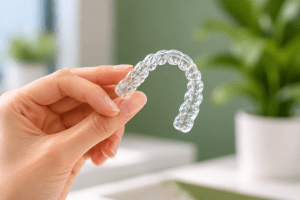
Approximately every two weeks, patients switch to the next set of aligners in their series. Each tray is designed to build precisely on the last, applying controlled force to guide teeth gradually into position.
It is a system that relies on continuity. Each step depends on the one before it. When that rhythm is maintained, the timeline tends to hold. When it is interrupted—whether by inconsistent wear or skipped intervals—the schedule shifts.
There is no mystery to it. The process simply reflects the inputs it receives.
What Actually Determines the Timeline
Some of the factors that influence treatment length are clinical. Others are personal.
The complexity of the case remains the most significant variable. Straightforward spacing issues require fewer aligners and less time. More involved corrections—overbites, crossbites, or crowding—require a longer sequence of movements.
Then there is wear time.
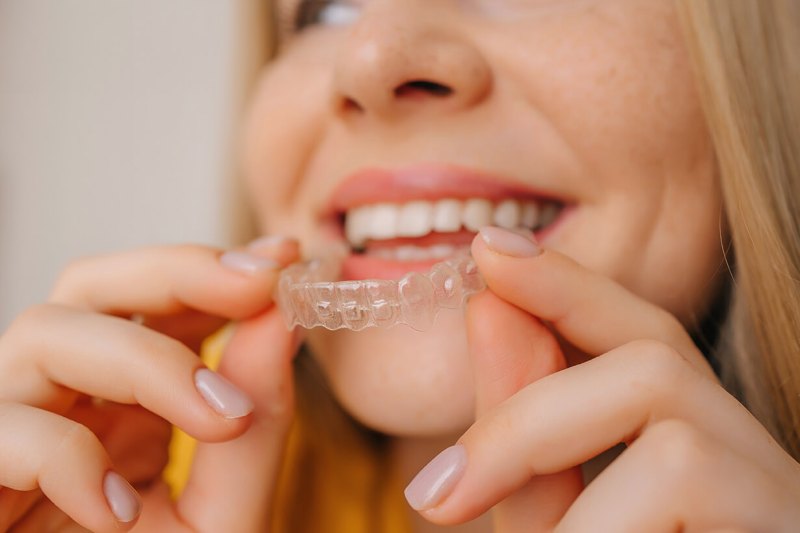
Aligners are designed to be worn for 20 to 22 hours each day, a threshold that allows for consistent pressure on the teeth. Patients who stay within that range tend to progress on schedule. Those who fall short, even slightly but repeatedly, often extend their own treatment timeline without realizing it.
And then there is biology—arguably the least predictable factor of all. Teeth move at different rates in different people. Younger patients often see faster changes, but even among adults, variability is the norm rather than the exception.
Which is why most orthodontists speak in ranges, not guarantees.

Technology as a Safeguard
In recent years, tools like remote monitoring have introduced a new layer of precision.
At Alinea Orthodontics, we use Dental Monitoring to track progress throughout your Invisalign timeline. Patients submit regular scans through the app, allowing our team to assess progress between visits and guide when it is time to move to the next aligner.
Small deviations—an aligner that is not fitting quite as expected, a tooth that is lagging behind—can be identified early and corrected before they affect the broader timeline.
How the Timeline Changes With Age
The Invisalign timeline is not uniform across life stages.
Teenagers often fall within the standard 12- to 18-month window, with consistency playing the defining role. Invisalign Teen includes wear indicators that provide a visual cue—subtle, but effective—for both patients and parents. Learn more about [adolescent orthodontic treatment at Alinea].
For younger children, treatment takes on a different form. Systems like Invisalign First are designed not to complete alignment, but to guide jaw development early, often resulting in a shorter initial phase followed by a period of observation. You can explore this further on our [early orthodontic treatment page].
Adults, meanwhile, represent the widest range. Some complete treatment in under a year. Others, particularly those addressing more complex concerns, may require closer to two. According to the American Dental Association, changes in bone density can influence the pace of movement—but consistent wear habits tend to narrow that gap considerably. See more about [adult orthodontics at Alinea].
The American Association of Orthodontists also notes that treatment timelines vary widely based on age, case complexity, and patient compliance—factors that apply across all orthodontic care.
After the Last Aligner
The timeline does not end when the final aligner comes out.
Teeth, once moved, retain a tendency to return to their original positions—a phenomenon orthodontists refer to simply as relapse. Retainers are designed to prevent it, holding the teeth in place while the surrounding bone stabilizes.
It is a quieter phase of treatment, but no less important. In many ways, it determines whether the results endure.
The Only Timeline That Matters
In the end, Invisalign is not defined by a universal clock.
It is shaped by a combination of planning, biology, and consistency—variables that make each case distinct. Estimates are useful. Ranges are necessary. But the only timeline that truly matters is the one that applies to you.

Where Your Timeline Becomes Clear
At Alinea Orthodontics in Santa Monica, every Invisalign treatment begins with a complimentary consultation and 3D scan, giving you a clear, personalized view of your timeline before anything begins.
No guesswork. No vague estimates. Just a plan designed around you.
Book your free consultation today or call (424) 428-0008 to get a timeline that fits your life.
For a limited time, Alinea is offering $1,000 off Invisalign treatment*—a meaningful shift in the overall investment for those considering starting now.
Conditions may apply.